
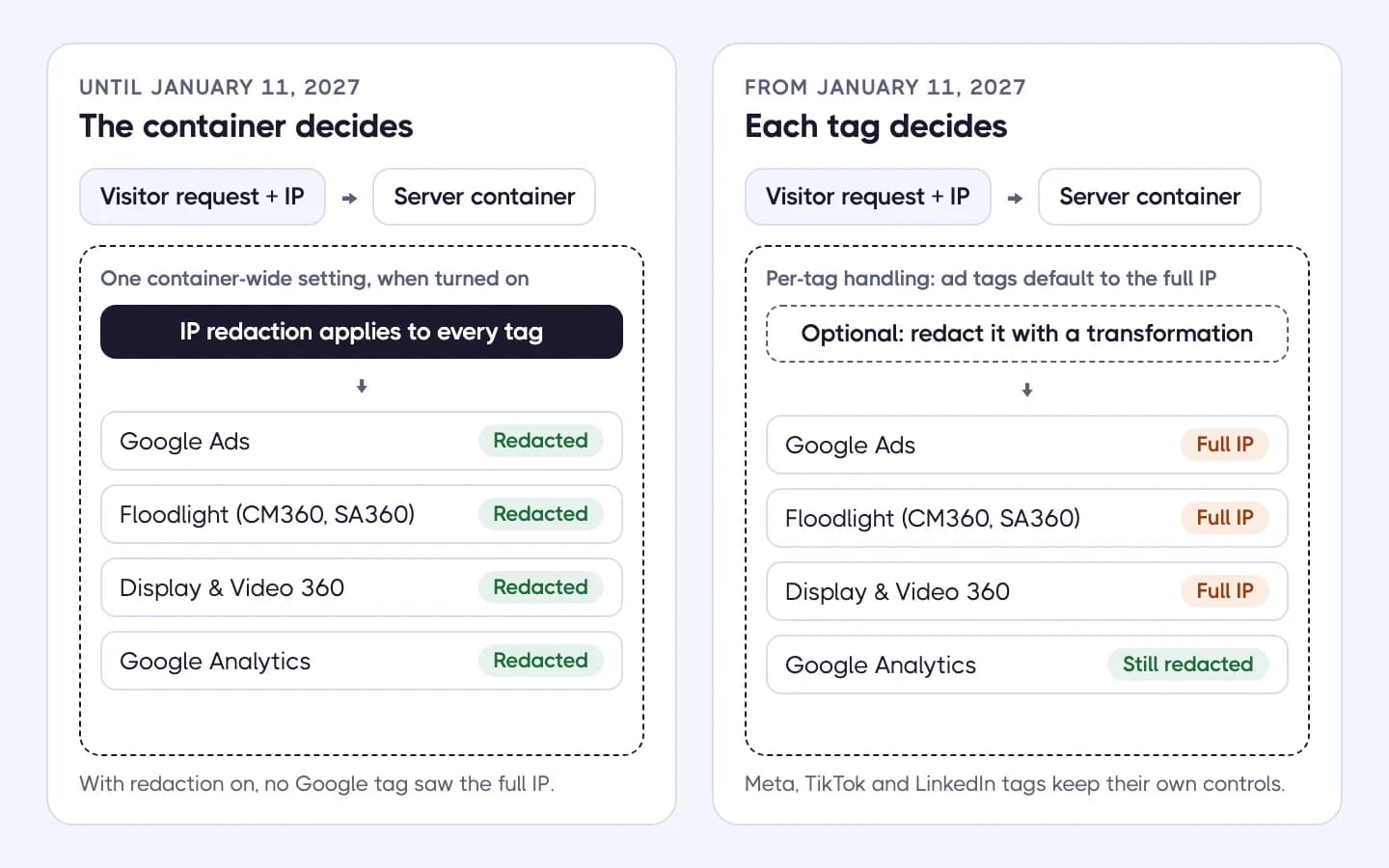
Starting January 11, 2027, server-side Google Tag Manager (sGTM) will send the full visitor IP address to Google Ads, Display & Video 360, Search Ads 360 and Campaign Manager 360 tags by default. Google Analytics keeps redacting it. If you moved to a server container to keep raw IPs away from ad platforms, and your setup relies on container-wide redaction, it may stop doing that on January 11.
Here’s what’s changing in server-side GTM
The news comes from a Google email, first shared on LinkedIn by Google Ads consultant Adriaan Dekker and reported by PPC Land on November 2, 2026. Google says that from January 11, 2027, server-side Tag Manager will “allow tags to process standard network signals like IP address.”
Until now, one container-level setting governed IP redaction for every tag. After the change, each tag decides. Here is what each kind of tag receives from that date, as Google’s email describes it:
| Tag in your server container | IP it receives from January 11 | What you need to decide |
|---|---|---|
| Google Ads (conversions and remarketing) | Full IP, by default | Full, partial or none, by region and consent |
| Floodlight (Campaign Manager 360 and Search Ads 360) | Full IP, by default | Full, partial or none, by region and consent |
| Display & Video 360 | Full IP, by default | Full, partial or none, by region and consent |
| Google Analytics | Redacted, as today | Nothing new; confirm it in preview |
| Third-party tags (Meta, TikTok, LinkedIn) | Set by each tag’s own controls | Check each tag’s IP settings |
Google gives three reasons: better ads measurement and personalization, privacy-enhancing technologies it does not name, and spam and invalid traffic filtering. It describes the new behavior as the default and says owners can opt out, pointing to a Help Center article for instructions without naming it.
One caveat up front. As of November 3, 2026, neither we nor PPC Land can find this change in Google’s public Tag Manager release notes. What Google does publish is a Help Center article, IP address redaction for server-side tagging. It shows how to use a transformation to send a partially redacted IP to tags such as Google Ads and Floodlight. It also notes that Google Analytics server tags already partially redact IPs. We will update this post when Google publishes formal documentation of the change.
Why full IP addresses carry privacy risk
IP addresses count as personal data under EU law and California’s privacy law. The EU Court of Justice held in Breyer (C-582/14) that even a dynamic IP address can be personal data for a website operator. California’s CCPA lists “Internet Protocol address” among the identifiers in its definition of personal information.
Healthcare adds its own layer. HHS guidance treated an IP collected on certain health pages as an identifier. A federal court vacated part of that guidance on June 20, 2024, but only the part about unauthenticated public pages.
Three things make this change easy to miss:
- Nothing to publish: Google’s email describes a new default, not a setting you turn on. It mentions no container update to approve.
- Old assumptions break quietly: if you chose server-side tagging to keep raw IPs away from ad platforms, your setup may stop doing that on January 11 while every tag keeps firing normally.
- Consent stays with you: Google’s email says notices and legally required consent are the advertiser’s job. EEA advertisers must follow its EU user consent policy, which also covers the UK and Switzerland. “We had redaction on” is a weak answer if it stopped applying.
When full IPs can help Google Ads measurement
Full IPs are not always the wrong answer. Google cites better measurement and invalid traffic filtering. Our inference is that, for consented traffic, a full IP also helps with location matching and conversion modeling, which can feed better bidding. Some advertisers will choose to let full IPs through for consented users.
The point is to make that choice on purpose instead of inheriting it from a default. Who should look first:
- Healthcare and health-adjacent brands: telehealth, clinics, pharmacy and wellness apps, given the pixel litigation. See our guide to healthcare tracking without PHI.
- Banks, credit unions and other sensitive categories: financial sites where visitors don’t expect to be identified. The bank tracking compliance guide covers the conservative design.
- Brands with EU, UK, Swiss or California traffic: where consent and privacy rules are strictest.
- Agencies running server containers for several clients: every container needs its own review and its own sign-off.
How to check IP redaction in server-side GTM before January 11
Work through these in order. The first three are an inventory; the rest are decisions and tests.
- Inventory every server container, including client containers you manage, and note who owns each one.
- List the affected tags in each container: Google Ads, Floodlight for Campaign Manager 360 and Search Ads 360, and Display & Video 360, with the triggers that fire them.
- Write down how you redact IPs today: a container setting, a transformation, a custom variable or a client configuration. If it depends on container-wide behavior, assume it changes on January 11.
- Decide per tag and per region whether each tag should get a full IP, a partial IP or none, and whether that depends on consent.
- Build redaction where you want it. Following Google’s IP redaction help article, add a transformation that replaces the
ip_overridevalue with a redacted one for the affected tags. Simo Ahava’s older walkthrough shows how that field carries the visitor IP. - Check consent mode end to end. Make sure the ad tags respect
ad_storageandad_user_data, and that your consent platform passes them through to the server container. Our Consent Mode v2 guide covers the signals. - Confirm in preview what each outgoing request carries, tag by tag, before January 11.
- Update your privacy policy and consent banner so they describe what you actually send.
- Test again after January 11, in preview and on live traffic, then record the decision and who signed off.
Save a measurement baseline first
If you let full IPs through, Google Ads numbers may move for reasons that have nothing to do with campaign performance. Google says the change improves measurement and invalid traffic filtering. Our inference is that location reports, modeled conversions and filtered clicks could shift for traffic that now carries a full IP. Google has published no figures.
Capture these before January 11:
- Daily Google Ads conversions by country for each account, with the conversion action and date basis in the export.
- Platform-to-backend ratio: Google Ads conversions divided by orders or qualified leads from your CRM, Shopify or backend, by country. Compare ratios, not raw counts.
- Invalid click and location report snapshots for the last 30 days.
- Annotated dashboards: mark January 11 on every chart that uses Google Ads, DV360 or CM360 data.
Keep the baseline in a file nobody will edit later. Change one thing at a time: if you edit consent or redaction on January 10, a before-and-after read can’t separate your change from Google’s.
Here’s what you can do
Start by making the decision explicit. For most advertisers, that means full IPs only for consented traffic in regions where counsel is comfortable, and redaction everywhere else. Build it, confirm it in preview and write it down. A default you inherited is still a decision.
For healthcare providers, banks, credit unions and other regulated clients, the setting is a legal decision as well as a measurement one. Our recommendation is to keep redaction on for every affected tag until counsel has reviewed the change, and to document the reason. This isn’t legal advice: what is acceptable depends on your industry, where your visitors are, and what your notices and consent say. Our job is making sure the setup does what you and your lawyer decided.
Agencies should treat this as a roster-wide task. One container per client means one decision per client, and the client should sign off on it. If you are new to server containers, the server-side tagging guide covers how they route data, and the tracking audit checklist covers the wider review.
Open questions
These are not answered in Google’s public materials as we read them:
- Which Help Center article holds the opt-out, and whether it is a container setting, a per-tag switch or a transformation.
- Whether full IPs feed conversion matching, attribution or modeled conversions. Google cites only “ads measurement.” Floodlight tags have sent unconsented requests to improve modeled conversions since July 28, 2025, and Google has not said whether those will carry the full IP.
- Whether a redaction transformation built today keeps working unchanged after January 11.
- Whether Google tag gateway setups are affected in the same way as server containers.
- Whether third-party tags’ IP behavior changes at all; the email says only that they keep their own controls.
We have not verified these. We will revisit this article when Google publishes answers.
Get the next one before it hits.
Short emails when Meta, Google, GA4 or LinkedIn change something that moves your numbers.
Part of: Server-side tagging
Also in Consent and privacy: Google Consent Mode v2, explained: basic vs advanced setup
Frequently asked questions
What changes in server-side Google Tag Manager on January 11, 2027?
According to a Google email reported by PPC Land on November 2, 2026, server-side Tag Manager moves IP handling from one container-wide setting to each tag. From January 11, 2027, tags that send data to Google Ads, Display & Video 360, Search Ads 360 and Campaign Manager 360 accept the full visitor IP address by default. Google Analytics tags keep redacting it.
Which server-side GTM tags will receive the full IP address?
Google Ads, Display & Video 360, Search Ads 360 and Campaign Manager 360 tags; Floodlight tags fall under Campaign Manager 360 and Search Ads 360. Google Analytics tags continue to redact IPs. Third-party tags such as Meta, TikTok and LinkedIn keep their own controls over the signals they accept.
Do I have to do anything before January 11?
If you do nothing, the four Google ad products start receiving full IPs from your server container. Google says owners can opt out and points to a Help Center article for instructions. Either way, decide per tag and per region whether each one should get a full IP, a partial IP or none, and record that decision.
How do I redact IP addresses in server-side GTM?
Google’s Tag Manager Help article on IP address redaction for server-side tagging describes using a transformation to send a partially redacted IP to tags such as Google Ads and Floodlight. In the server container, the visitor IP travels in the event data field ip_override. Build the transformation for the affected tags, then confirm in preview mode what each outgoing request carries.
What is ip_override in server-side GTM (sGTM)?
ip_override is the event data field in a server-side GTM container that carries the visitor’s IP address to outgoing tags. A transformation or tag setting that clears or redacts ip_override controls what IP a tag sends on. Check it in preview mode, tag by tag, rather than assuming a container-wide setting covers it.
Is an IP address personal data?
Under EU law and California’s CCPA, yes. The EU Court of Justice held in Breyer (2016) that a dynamic IP address can be personal data for a website operator. California’s CCPA lists Internet Protocol address among the identifiers in its definition of personal information.
Does Google’s change affect consent requirements?
Google says the requirements still apply. Its email says proper end-user notices and legally required consents must be in place before data collection begins, and that advertisers in the EEA must follow Google’s EU user consent policy. That policy covers the EEA, the UK and Switzerland. Consent remains the advertiser’s responsibility.
Will my Google Ads conversion numbers change?
They may. Google says the change improves ads measurement and invalid traffic filtering, so location matching and modeled conversions could shift for traffic that now carries a full IP. That is our inference, not a Google figure. Save a baseline of Google Ads conversions against backend orders or leads, by country, before January 11.
Should healthcare and banking clients let full IPs through?
That is a legal and privacy decision for the client, made with counsel, not by the media team alone. HHS has treated IP addresses collected on certain health pages as identifiers, and a federal court vacated only part of that guidance in 2024. Our recommendation for healthcare and banking clients is to keep redaction on until counsel has reviewed the change.
Sources and references
- PPC Land, “Google ad tags gain full visitor IP addresses in server-side GTM in 2027” (November 2, 2026)
- Adriaan Dekker, LinkedIn post sharing Google’s advertiser email (November 2, 2026)
- Google Tag Manager Help, IP address redaction for server-side tagging
- Google, EU user consent policy
- Simo Ahava, #GTMTips: Get true IP anonymization with server-side tagging
- California Civil Code § 1798.140 (CCPA definitions)
- Simmons & Simmons, CJEU: dynamic IP addresses may be personal data (Breyer, C-582/14)
- Hunton Andrews Kurth, AHA v. Becerra ruling on HHS tracking guidance (June 20, 2024)